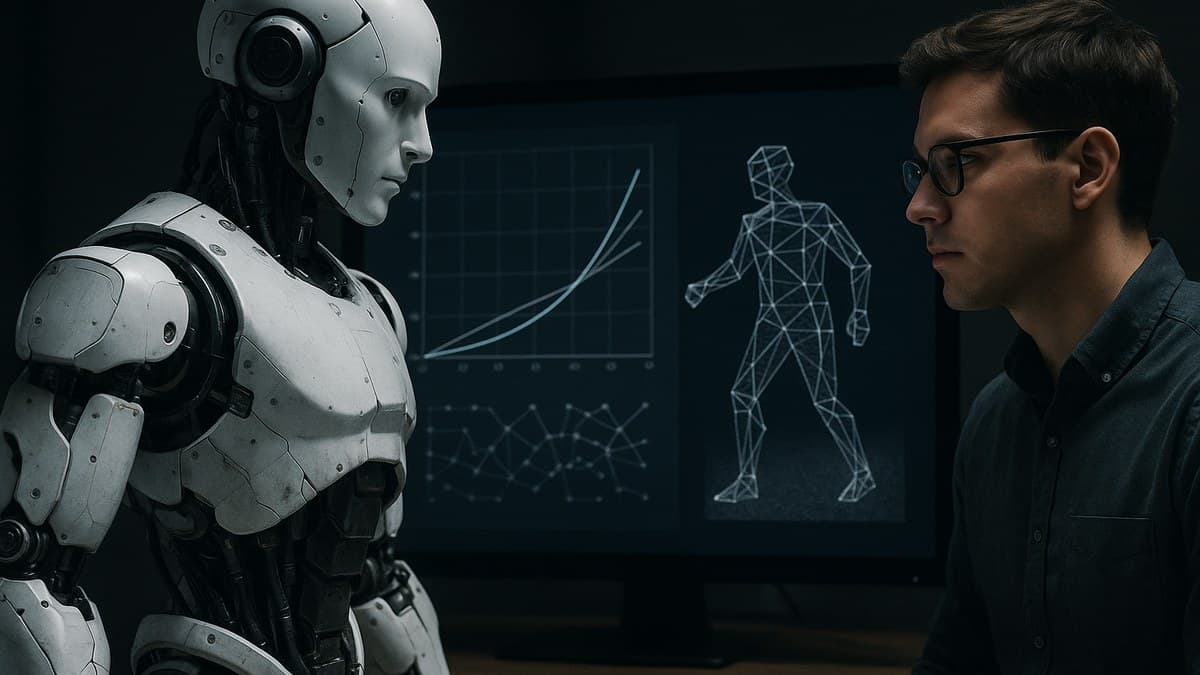
AI Research Rundown: Humanoid Motion, Graph Reasoning, and 3D Imaging

Key insights from the latest papers on AI advancements.

February 19, 2026•2 min read

ScienceToStartup Editorial

Good morning, AI enthusiasts. Today's article highlights significant advancements in AI research, focusing on humanoid motion learning, personalized graph reasoning, and 3D data analysis. These developments are shaping the future of AI applications across various domains.

AI Research Rundown: Humanoid Motion, Graph Reasoning, and 3D Imaging

In today's rundown

The Rundown

The University of XYZ just introduced MeshMimic, a important framework that enables humanoid robots to learn motion-terrain interactions using only consumer-grade monocular sensors. This innovative approach leverages advanced 3D scene reconstruction to achieve dynamic performance across various terrains. Experimental results show that MeshMimic significantly reduces reliance on expensive motion capture data, proving effective in real-world applications.

The details

  • MeshMimic utilizes current best 3D vision models to reconstruct human trajectories and terrain geometry, enhancing motion learning accuracy.
  • The framework's kinematic consistency optimization algorithm extracts high-quality motion data from noisy visual inputs, improving interaction fidelity.
  • Experimental trials demonstrate robust performance in dynamic environments, with the system adapting to diverse and challenging terrains.

Why it matters

MeshMimic represents a significant shift in humanoid robotics, providing a cost-effective solution for training complex physical interactions. This innovation opens up new opportunities for deploying humanoid robots in unstructured environments, potentially transforming industries such as logistics and service automation.

The Rundown

The team behind RUVA has developed a novel "Glass Box" architecture that allows users to manage their Personal AI more transparently. By grounding AI in a Personal Knowledge Graph, RUVA enables precise redaction of sensitive information and enhances accountability. This shift from traditional vector databases to graph reasoning marks a significant advancement in user control over AI systems.

The details

  • RUVA empowers users to inspect their AI's knowledge base, providing a clear view of the data being utilized.
  • The architecture facilitates precise redaction, ensuring that users can effectively manage their personal information.
  • By shifting to graph reasoning, RUVA addresses the accountability issues inherent in conventional AI systems.

The Rundown

A new pipeline for 3D data analysis has emerged, utilizing Bayesian optimization to streamline segmentation and classification in biomedical imaging. This method addresses the challenges of model selection and parameter tuning, significantly improving efficiency in data processing. The pipeline's design includes an assisted class-annotation workflow that reduces manual efforts in annotation tasks.

The details

  • The 3D data Analysis Optimization Pipeline selects and optimizes segmentation models using a domain-adapted benchmark dataset.
  • A new segmentation quality metric serves as the objective function, ensuring concise evaluation of performance.
  • The pipeline's assisted class-annotation workflow minimizes manual annotation efforts, enhancing operational efficiency.

Why it matters

This optimization pipeline represents a crucial advancement in biomedical imaging, enabling faster and more accurate analysis of complex 3D datasets. By reducing the manual workload, it allows researchers to focus on critical insights and applications in healthcare.

Community AI Usage

Every newsletter, we showcase how a reader is using AI to work smarter, save time, or make life easier.

COMMUNITY INSIGHT in šŸ’¬

ā€œI’m a data scientist working on AI-driven agriculture tools. I recently used the AgriWorld framework to analyze crop yield data. It helped me simulate various growth conditions and predict outcomes accurately, making my analysis much more robust.ā€

Trending AI Tools and AI Research

šŸ“ˆ

A platform for tracking experiments, datasets, and model performance.

🧠

A flexible framework for building and training ML models.

šŸ¤—

A library for NLP, vision, and multimodal tasks with pre-trained models.

šŸ”„

An intuitive platform for deep learning research and production.

šŸ”§
CursorSponsor

Built to make you extraordinarily productive, Cursor is the best way to code with AI.

šŸ“Š

An open platform for managing the full ML lifecycle.

Everything Else

Microsoft offers a guide for using pirated content for LLM training.

Ladybird Browser ends its pursuit of Swift adoption.

A new website, All Look Same?, explores visual perception.

Sizing Chaos examines women's clothing sizes.

Google Cloud's VP discusses startup challenges in a recent video.

Frequently Asked Questions

MeshMimic is a framework for humanoid motion learning that uses 3D scene reconstruction to enable robots to learn motion-terrain interactions.
RUVA provides a 'Glass Box' architecture that allows users to inspect and manage their AI's knowledge, enhancing accountability.
The pipeline streamlines segmentation and classification in biomedical imaging using Bayesian optimization to improve efficiency.
Personalized AI enhances user control and privacy, allowing individuals to manage their data and interactions with AI systems.
Bayesian optimization uses probabilistic models to select and tune parameters for machine learning models, improving performance.
AgriWorld provides tools for geospatial queries and crop growth simulations, improving analysis and decision-making in agriculture.
It addresses the imbalance in label distributions, ensuring that rare labels are effectively learned without disrupting inter-label dependencies.
It allows users to manage their personal data and ensure that sensitive information can be effectively redacted from AI systems.
The pipeline includes an assisted class-annotation workflow that minimizes the need for manual tracking and annotation.
Curiosity drives exploration in under-represented labels, improving learning efficiency without manual balancing.
By using 3D scene reconstruction, MeshMimic allows robots to learn motion interactions in a cost-effective manner.
RUVA can be applied in personal data management across various sectors, enhancing user trust in AI technologies.
The pipeline analyzes large-scale biomedical imaging data, particularly focusing on 3D datasets.
Segmentation is crucial for accurately identifying and classifying regions of interest in medical images.
Industries such as healthcare, agriculture, and robotics stand to benefit significantly from these AI advancements.

Related Articles

Help us improve ScienceToStartup experience for you