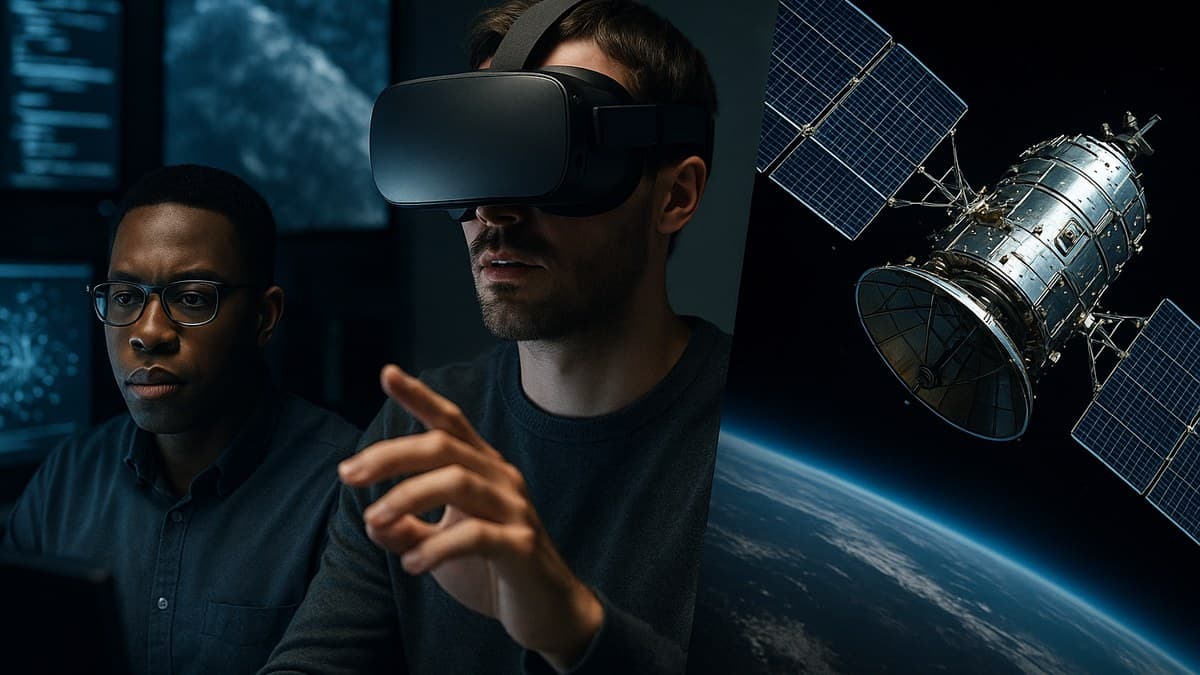
AI Research Rundown: Satellite Detection, VR Simulation, and Legal Predictions

Key insights from the latest papers on AI advancements.

February 24, 2026•2 min read

ScienceToStartup Editorial

Good morning, AI enthusiasts. Today's article highlights significant advancements in AI research, focusing on satellite-based detection of looted archaeological sites, motion generation for virtual reality games, and AI-driven legal judgment predictions. These developments are reshaping the landscape of cultural heritage, gaming, and legal technology.

AI Research Rundown: Satellite Detection, VR Simulation, and Legal Predictions

In today's rundown

The Rundown

Microsoft Research unveiled a important approach to monitor looted archaeological sites using satellite imagery. Their scalable pipeline, leveraging PlanetScope's 4.7m/pixel monthly mosaics, analyzes a curated dataset of 1,943 sites in Afghanistan — 898 of which have been looted. The model employs end-to-end CNN classifiers trained on raw RGB patches, achieving an impressive F1 score of 0.926, significantly outperforming traditional machine learning methods that only reached 0.710. This innovation not only enhances the ability to protect cultural heritage but also sets a new benchmark for remote sensing applications in archaeology.

The details

  • The CNN model trained on RGB patches achieved an F1 score of 0.926, while the best traditional ML setup scored only 0.710.
  • The dataset included 898 looted and 1,045 preserved archaeological sites, providing a comprehensive training ground for the model.
  • Ablation studies confirmed that ImageNet pretraining and spatial masking were critical to achieving high performance.
  • Geospatial foundation model embeddings showed competitive results, indicating that looting signatures are highly localized.

Why it matters

This research positions Microsoft as a leader in utilizing AI for cultural preservation. The ability to detect looted sites at scale can significantly aid governments and organizations in safeguarding heritage, potentially influencing policy and funding in archaeology.

The Rundown

A new player model named Robo-Saber has emerged from research aimed at enhancing virtual reality (VR) gaming experiences. Developed using the BOXRR-23 dataset, Robo-Saber generates realistic movements for VR headset and controller interactions based on in-game object arrangements. Tested on the popular game Beat Saber, the model captures diverse player behaviors and skill levels, optimizing gameplay performance. This innovation promises to streamline playtesting processes and could revolutionize how developers approach VR game design, making it more data-driven and efficient.

The details

  • Robo-Saber was trained on the BOXRR-23 dataset, which includes a wide variety of player movements.
  • The model aligns movements with gameplay scores, maximizing effectiveness during playtesting.
  • Robo-Saber's ability to mimic diverse player behaviors could lead to more tailored gaming experiences.
  • The framework demonstrates potential for predictive applications in game design and development.

Why it matters

Robo-Saber's development reflects a growing trend in the gaming industry towards data-driven design. By simulating player behavior, developers can refine gameplay mechanics and enhance user engagement, potentially leading to higher sales and player retention.

The Rundown

Vichara, a novel AI framework, has been introduced to predict and explain appellate judgments within the Indian judicial system. This system processes English-language appellate documents, breaking them down into decision points that encapsulate core legal determinations. Evaluated on two datasets, Vichara outperformed existing benchmarks, with the GPT-4o mini model achieving an F1 score of 81.5. Its structured explanations, inspired by the IRAC framework, enhance interpretability, allowing legal professionals to assess predictions effectively, making it a valuable tool in managing case backlogs.

The details

  • Vichara achieved an F1 score of 81.5 on the PredEx dataset, outperforming all existing models.
  • The framework uses a structured format for explanations, improving clarity and usefulness for legal professionals.
  • Human evaluations highlighted the superior interpretability of predictions generated by Vichara.
  • The model processes legal documents to isolate decision points, enhancing prediction accuracy.

Why it matters

Vichara's introduction could significantly alleviate the backlog of cases in Indian courts by providing timely predictions and explanations. This tool not only enhances efficiency but also improves transparency in the legal process, potentially transforming legal practice.

Community AI Usage

Every newsletter, we showcase how a reader is using AI to work smarter, save time, or make life easier.

Community Insights in šŸ‘„

ā€œI’m a legal tech consultant, and I recently started using Vichara for predicting appellate judgments. The results have been impressive — it not only predicts outcomes but also explains the reasoning, making it easier for me to advise clients on case strategies.ā€

Trending AI Tools and AI Research

šŸ”§
CursorSponsor

Built to make you extraordinarily productive, Cursor is the best way to code with AI.

šŸ”—

A framework for building applications powered by LLMs.

šŸ“Š

An open platform for managing the full ML lifecycle.

šŸ“ˆ

A platform for tracking experiments, datasets, and model performance.

šŸ¤—

A library for NLP, vision, and multimodal tasks with pre-trained models.

🧠

A flexible framework for building and training ML models.

Everything Else

Tesla registrations in Europe fell 17% in January 2026, despite a 14% surge in the BEV market.

The Manjaro website went offline due to a lapsed SSL certificate.

An innovative project hacks older Kindles to display real-time bus arrival information.

OpenAI and Persona are reportedly collaborating on an identity surveillance system.

Steel Bank Common Lisp continues to be a popular choice among developers.

Frequently Asked Questions

Robo-Saber is a motion generation system for VR games that simulates player movements based on in-game object arrangements.
Vichara predicts appellate judgments and provides structured explanations, improving clarity and usefulness for legal professionals.
Robo-Saber was trained on the BOXRR-23 dataset, which includes diverse player movements for VR gaming.
The satellite detection model achieved an F1 score of 0.926, significantly outperforming traditional methods.
This research helps protect cultural heritage by enabling the detection of looted archaeological sites at scale.
Vichara processes legal documents to isolate decision points and uses large language models for predictions.
Robo-Saber generates realistic player movements, allowing developers to test gameplay mechanics more effectively.
The paper focuses on using satellite imagery to detect looted archaeological sites in Afghanistan.
Vichara provides explanations in a structured format, improving understanding of legal predictions.
Robo-Saber can be used for playtesting VR games and synthesizing gameplay data for predictive applications.
The F1 score measures a model's accuracy, balancing precision and recall, which is crucial for evaluating performance.
The goal is to monitor and protect archaeological sites from looting using advanced machine learning techniques.
Robo-Saber aligns movements with gameplay scores, mirroring the skill levels specified by input style exemplars.
Vichara aims to reduce case backlogs by predicting outcomes of appellate cases efficiently.
The model represents advancements in remote sensing and machine learning for cultural heritage preservation.

Related Articles

Help us improve ScienceToStartup experience for you